World of Rugs Region 01
PERSIA Region 01  ·  Middle East  ·  Iran

The birthplace.
2,500 years of craft tradition.

From nomadic Qashqai tribes to royal Isfahan workshops — the most diverse rug-weaving tradition on earth. The dyes, knots, and materials that define Persian rugs determine everything about how we care for them.

Explore rug styles ↓ How we clean Persian rugs ↓
Knot TypeAsymmetric (Persian / Senneh)
Primary FiberKork wool · Silk · Cotton
Dye TraditionMadder · Indigo · Pomegranate
Weaving StylesCity · Village · Nomadic
Tradition Age2,500+ years
UNESCO RecognitionIntangible Heritage — 2010
Understanding Persian rugs

No other rug-producing country comes close to the diversity of Persian weaving traditions.

City workshops, mountain villages, and nomadic tribes across Iran each produce rugs with completely distinct construction, materials, and design vocabulary. A Kashan workshop rug and a Qashqai nomadic piece share the same knot type — but almost nothing else.

The asymmetric Persian knot (also called the Senneh knot) is tied around one warp thread and looped under the adjacent one. This allows finer detail than the symmetric Turkish knot, and is the foundation of the most intricate rug designs in the world.

Understanding which tradition your rug comes from — city vs. village vs. nomadic, which region, which materials — is the first step in knowing how to care for it. A 200-year-old Tabriz antique and a contemporary Kashan workshop rug require completely different handling.

At Simonian: We identify every Persian rug at intake — city vs. village vs. nomadic, knot density, dye system, age assessment — before any water or chemistry comes near it. This is what 70 years of expertise looks like in practice.
Three weaving traditions — one country
City Workshops
Formal workshops, master weavers, design cartoons, finest materials. Kashan, Isfahan, Tabriz, Qom.
Village Weavers
Fixed looms, more individuality, simplified designs. Heriz, Hamadan, Bijar, Sarouk.
Nomadic Tribes
Portable horizontal looms, woven from memory. Qashqai, Bakhtiari, Baluchi, Afshar.
Construction guide

How a hand-knotted rug is built.

Understanding construction is how we know what every rug needs. Three things to know: the anatomy, the knot type, and the knot density.

Part 1 of 3 — Rug anatomy cross-section
Fringe — exposed warp ends Pile Cut knot ends — wool, silk or viscose Weft Horizontal — secures knot rows Knot row Tied around warp pairs Warp Vertical — runs full rug length Kilim end Pileless warp + weft band Fringe Exposed warp ends Overcasting Selvedge sides Foundation Cotton or wool warp + weft
Part 2 of 3 — Persian knot vs Turkish knot
Persian / Senneh knot — asymmetric
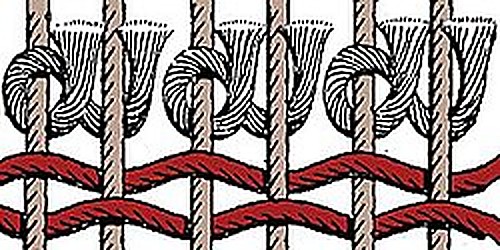
Persian asymmetric knot diagram — Wikipedia
Wraps fully around one warp, passes loosely under the adjacent one. The open side can lean left or right (S or Z).
Allows higher knot density — more knots per square inch, finer curvilinear patterns.
Used in: Persia (most regions) · India · China · Pakistan
Turkish / Ghiordes knot — symmetric
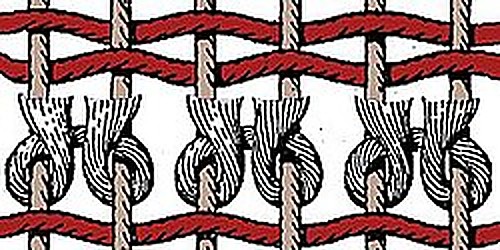
Turkish symmetric knot diagram — Wikipedia
Wraps fully around both warps symmetrically. Both pile ends emerge between the same two warps.
Produces a denser, more durable pile — preferred for geometric designs and tribal pieces.
Used in: Turkey · Caucasus · NW Iran (Kurdish, Tabriz)
At Simonian: We identify knot type at intake — asymmetric vs symmetric, single vs double weft — because it determines pile direction, cleaning tension, and drying protocol. Images courtesy Wikimedia Commons (public domain).
Part 3 of 3 — Knot density quality guide (KPSI)
Under 30 KPSI
Very coarse — simple tribal flat-weaves, Gabbeh
30–60 KPSI
Coarse — Heriz village, Afghan tribal
60–130 KPSI
Medium fine — most workshop rugs
130–160 KPSI
Fine — Kashan, Isfahan, Tabriz city rugs
160–290 KPSI
Very fine — Nain, fine Kashan, Kashmir silk
290+ KPSI
Extremely fine — Qom all-silk (up to 1,000+ KPSI)
finer →
The evolution of Persian craft

How the techniques developed.

A timeline of weaving innovation — focused on the craft, the materials, and the people who developed them.

~500 BCE
Ancient Persia
The Pazyryk — earliest known knotted pile carpet
Found frozen in a Scythian burial mound in Siberia, the Pazyryk carpet (now in the Hermitage) demonstrates that the asymmetric Persian knotting technique was already fully developed. Fine wool pile, detailed borders, approximately 225 knots per square inch — a level of technical mastery that implies centuries of prior development. Natural dyes including madder and weld are identifiable in the surviving fibers.
Asymmetric knot — established Natural madder dyes 225 KPSI
1501–1736
Safavid Dynasty
Royal workshops and the central medallion design
Shah Abbas I established royal ateliers in Isfahan where master designers created cartoons — scaled drawings that weavers followed knot by knot. This standardized the central medallion format, arabesque scrollwork, and garden designs. Silk foundations allowed unprecedented knot density. Kork wool from highland sheep gave the pile its famous luminosity. The Ardabil Carpet (1539–40, now V&A London) represents the pinnacle of this era — 340 knots per square inch across 26 square meters.
Design cartoons introduced Silk foundation — higher KPSI Kork wool pile Central medallion standardized
1850s
Industrial era
Synthetic aniline dyes — the craft turning point
The introduction of synthetic aniline dyes from European chemical factories transformed — and in many cases damaged — Persian rug production. Aniline dyes were cheaper and easier than traditional madder, indigo, and pomegranate processes, but produced colors that faded dramatically and were highly fugitive when wet. Rugs from this transition period (1860s–1920s) often show severe dye instability and require specialist handling. This is why dye testing is mandatory at inspection for any piece of uncertain age.
Aniline dyes — fugitive Natural dye decline Critical inspection period
1920s–Now
Modern era
Chrome dyes, natural dye revival, and the Gabbeh phenomenon
Chrome mordant dyes (introduced 1920s) are stable synthetic dyes used in most modern workshop production — colorfast, consistent, and safe to clean. Simultaneously, collectors and designers rediscovered Gabbeh rugs woven by Qashqai nomads — abstract, thick-piled pieces in vivid natural dye colors that became hugely popular in Western interiors. A natural dye revival movement now produces both fine workshop rugs and tribal-style pieces using traditional madder, indigo, and cochineal.
Chrome dyes — stable Natural dye revival Gabbeh — abstract tribal UNESCO recognition 2010
Fibers & Materials

What Persian rugs are made of.

The fiber determines everything — pH tolerance, moisture absorption, drying behavior, and pile texture. Identifying it correctly is step one of every cleaning assessment.

🐑
Kork Wool
Neck & shoulder fleece · Iranian highland sheep
The finest Persian wool comes from the neck and shoulder of highland sheep raised at altitude. Kork wool has longer, finer fibers with exceptional natural lanolin content — resists dirt, absorbs natural dyes brilliantly, and develops a luminous sheen with age and use. The defining material of fine city workshop rugs.
Used in: Kashan · Isfahan · Tabriz · Nain city rugs
🪡
Pure Silk
Bombyx mori · Caspian region
Silk allows the highest possible knot density — up to 1,000 KPSI in exceptional Qom pieces — and produces an unmistakable luminosity and color depth. All-silk rugs (pile and foundation) require pH-neutral chemistry only. Alkaline solutions dissolve the protein structure of silk permanently and irreversibly.
Used in: All-silk Qom · fine Isfahan · luxury Kashan silk warps
🌿
Cotton Foundation
Warp & weft · most city rugs
Cotton warps are stronger than wool warps under tension, allowing tighter knot packing and flatter, more stable rugs. Cotton doesn't stretch or shrink as unevenly as wool. The combination of cotton foundation with kork wool pile is the hallmark of quality Persian city workshop construction.
Used in: Foundation warp & weft in most city & workshop rugs
🐪
Tribal Wool
Handspun · nomadic & village weavers
Nomadic and village weavers use locally-raised, handspun wool. The variation in thickness and twist creates the subtle color variations called “abrash” — horizontal bands of slightly different shades that are a cherished characteristic of tribal pieces. Coarser than kork wool but extremely durable.
Used in: Qashqai · Bakhtiari · Baluchi · Heriz village rugs
⚠️
Viscose (Art Silk)
Mercerized cotton or rayon · modern production
Viscose is often sold as “art silk” and looks convincingly like real silk to the untrained eye. It is extremely fragile when wet — it loses structural integrity, flattens permanently, and can be destroyed by aggressive cleaning. Identifying viscose vs. real silk at inspection is critical. Burn test and feel are the primary identification methods.
⚠️ Requires specialized care — never aggressive cleaning
🧵
Silk Warp Threads
Foundation only · fine city rugs
Fine city rugs often use silk warp threads with wool pile. Silk warps allow even tighter knot packing than cotton — enabling the extraordinarily high knot counts of Nain and fine Isfahan rugs. These pieces require special handling: the silk foundation is vulnerable even when the wool pile is robust.
Used in: Fine Nain · Isfahan · some Kashan foundation threads
Dye Traditions

Color from the earth.

Natural dyes produce the complex, mellowing colors that antique Persian rugs are valued for — a quality no synthetic dye can replicate. Each dye has a distinct chemistry that determines how we approach it at inspection.

Madder Root
Rubia tinctorum · Iran · Turkey · Central Asia
The most important red dye in rug history. Colors range from pale pink to deep burgundy depending on mordant and preparation. Madder reds mellow beautifully with age, developing complex amber undertones that synthetic reds never achieve.
✓ Generally stable — test recommended on antiques
Indigo
Indigofera tinctoria · India · Iran · Egypt
Produces the deepest blues and blue-greens in rug history. A vat dye requiring no mordant but careful preparation. True indigo blues develop a rich patina with age, fading to softer blue-gray tones prized in antique pieces. Greens are created by overdyeing yellow with indigo.
✓ Stable — generally safe to clean
Pomegranate Rind
Punica granatum · Iran · widespread
Produces gold and warm yellow tones with excellent mordant adhesion. Yellow dyes are the least stable natural dyes — the pale ivory tones in many antique Persian rugs are often yellows that have faded over centuries. Combined with indigo, pomegranate yields greens from olive to emerald.
⚡ Variable stability — test all yellows
Cochineal
Dactylopius coccus · originally Mexico · Iran via trade
Produces brilliant crimson, rose, and purple tones. Widely used from the 17th century onward via trade routes. Can be fugitive — some cochineal pinks and purples bleed when wet. Making dye testing critical at inspection for any piece with rose or purple tones.
⚠ Potentially fugitive — always test before cleaning
Aniline Synthetics
Chemical industry · introduced ~1850s–1920s
Synthetic dyes introduced from European chemical factories. Vivid colors but often highly fugitive — pieces from the 1860s–1920s frequently show severe dye instability and bleed dramatically when wet. Rugs from this period are the most dangerous to clean incorrectly.
⚠ High bleed risk — mandatory testing before any moisture
Chrome Mordant
Modern synthetic · introduced ~1920s
Chrome mordant dyes are stable synthetic dyes used in most modern workshop production. Colorfast, consistent, and safe to clean with standard chemistry. Most contemporary Persian city rugs (post-1920s) use chrome dyes — a reliable indicator that the piece is cleanable with standard protocols.
✓ Very stable — standard cleaning protocols apply
Important for cleaning: Natural dyes in Persian rugs — particularly antique pieces — require individual zone testing before any moisture is introduced. Madder reds and indigo blues are generally stable; cochineal pinks and early aniline synthetic dyes (1860s–1920s) can be highly fugitive. This is exactly why every Persian rug is inspected before any cleaning begins.
Identifying Persian Rug Styles

Which style is yours?

City workshops, village weavers, and nomadic tribes each produce rugs with distinct visual and structural characteristics. Use these to help identify your piece.

Kashan
City Workshop · Central Iran
Kashan
Central medallion with intricate floral arabesque scrollwork on rich red, navy, or ivory ground. Uses kork wool exclusively for the finest pieces. The name “Mohtasham Kashan” refers to legendary 19th-century master pieces that are among the most valuable antiques.
Kork wool pile Cotton foundation 120–200 KPSI Floral medallion
Isfahan
City Workshop · Central Iran
Isfahan
Symmetrical floral arabesques with a single medallion, often on ivory ground with indigo and madder accents. Frequently uses silk foundation with wool pile, or combined wool-silk pile for exceptional luminosity. Safavid design heritage.
Wool or silk pile Silk or cotton warp Safavid designs
Tabriz
City Workshop · Northwest Iran
Tabriz
The widest variety of designs of any Persian city — medallions, hunting scenes, garden patterns, pictorial. Uses a distinctive metal hook (tak) for tying knots. Pile usually wool on cotton; finest pieces use silk accents. The Ardabil Carpet is the most famous Tabriz production.
Asymmetric knot (tak) Widest design range Wool/silk pile
Qom (Qum) Silk
City Workshop · Central Iran
Qom (Qum) Silk
The most technically demanding rugs made anywhere. Every thread — warp, weft, and pile — is pure silk. Knot counts from 300 to over 1,000 per square inch. Require specialist care only; pH-neutral chemistry is mandatory as alkaline solutions destroy silk protein permanently.
All-silk pile & foundation 300–1000+ KPSI Extreme delicacy
Heriz
Village · Northwest Iran
Heriz
Bold geometric interpretation of the medallion design in rich reds and blues. Coarser construction than city rugs but exceptionally durable — ideal for high-traffic living rooms. The Gorevan (lower grade) and Serapi (finer grade) are both from this region. One of the most popular village rug styles worldwide.
Bold geometric Village construction Very durable Wool pile & foundation
Qashqai
Nomadic Tribe · Zagros Mountains · SW Iran
Qashqai
Geometric medallions, animal motifs, and the legendary Gabbeh — thick-piled abstract rugs woven from pure imagination with no formal design pattern. One of the largest nomadic confederations in Iran; their tribal pieces feature handspun naturally-dyed wool with the characteristic “abrash” color variation.
Wool on wool Natural dyes Handspun Geometric & Gabbeh
Not sure which style you have?
Walk in with your rug — or a clear photo of front, back, and any label. We'll identify it for free.
Clean my Persian rug →
Simonian's approach

How we clean
Persian rugs.

Persian rugs are the most complex rugs to clean correctly. A 200-year-old Tabriz antique, a 1960s Qashqai tribal piece, and a contemporary Kashan workshop rug all require completely different chemistry, moisture levels, and handling.

This is precisely why inspection comes first. Every Persian rug is assessed across all six dimensions before water or chemistry comes near it. 70 years of experience cleaning Persian rugs is our advantage — not equipment. Equipment can be purchased. The knowledge to read a Tabriz knot structure, recognize fugitive aniline dyes from the 1890s, and understand what a Gabbeh needs cannot.

Note on antique Persian rugs
Pieces over 100 years old require special handling. We use the Mor machine — older equipment designed for gentleness over speed — and hand-finish every antique. The natural dye patina that develops over a century is irreplaceable and must be preserved, never “brightened.”
1
Origin & age identification
City workshop vs. village vs. tribal vs. nomadic. Approximate age and dynasty. Construction type and knot confirmed at intake.
2
Dye zone testing — every color
Every color zone individually tested for colorfastness. Madder, indigo, pomegranate, and cochineal all behave differently when wet. Aniline dyes from pre-1920 pieces flagged as high risk.
3
Fiber & knot assessment
Kork wool vs. ordinary wool vs. silk vs. viscose. Knot density measured. Foundation integrity — especially warp tension — evaluated for antiques.
4
pH-matched chemistry selection
Wool: pH 4.5–5.5. Silk: strictly pH-neutral. Alkaline solutions dissolve silk protein and destroy natural dye mordants permanently.
5
Full immersion & The Flush
Full immersion in pH-balanced solution. The Flush: water pushed back-to-front until clean. The step most cleaners skip — and the step that makes the biggest difference.
6
Tension drying — pile direction set
Stretched flat under controlled tension. Pile combed in direction while still slightly damp. Antiques dried slower and gentler — the rug leaves when it's ready, not when the schedule says so.
70 years of Persian rug expertise

Have a Persian rug that needs care?

Walk in with your rug — or a photo. We'll identify it, tell you what it needs, and give you an honest assessment. No charge for the evaluation.

Design a custom rug → Browse Persian Rugs → Clean my Persian rug →