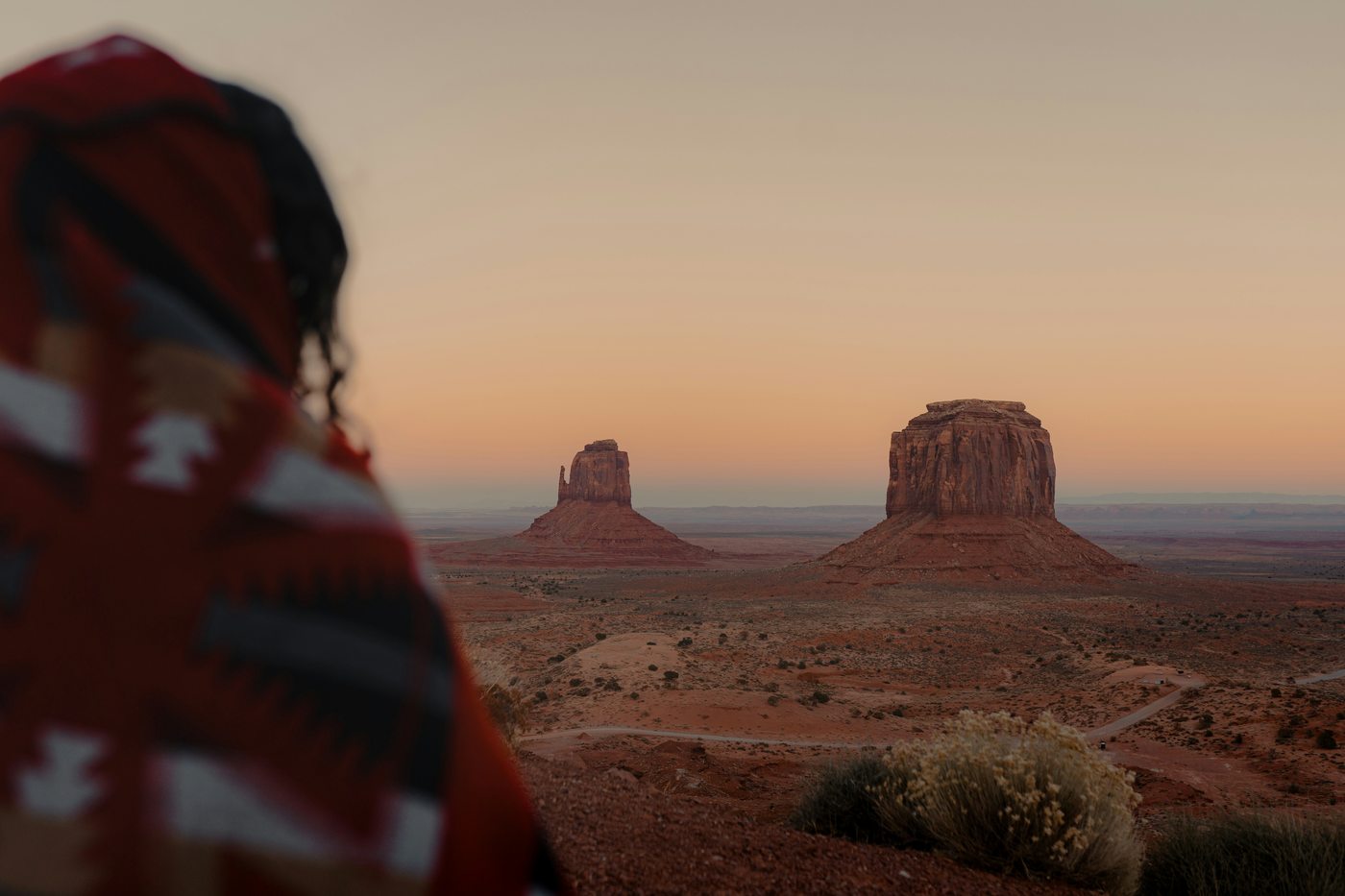
Monument Valley at sunset, Navajo Nation
Regions of Origin · Region 14
Arizona · New Mexico · Utah

Navajo

The greatest weavers in North American history. For over 400 years, Navajo artists have transformed churro wool into flat-woven textiles of extraordinary geometric power — work that hangs in the world's finest museums and anchors the most significant Native American art collections.

400+Years of Tradition
0Knots — Woven Flat
100%Upright Loom
Technique
Weft-faced plain weave on upright loom — no knots, no pile
Fiber
Churro wool; handspun; occasionally raveled bayeta trade cloth
Key Regions
Two Grey Hills, Ganado, Crystal, Wide Ruins, Teec Nos Pos
Iconic Styles
Chief blanket, Ganado, Eye Dazzler, Two Grey Hills
Hallmark
No fringe, no pile — bold flat geometry woven on an upright loom

North America's Greatest Weaving Tradition

The Navajo did not always weave. They learned the upright loom from the Pueblo peoples of the Rio Grande in the early 18th century and, within a generation, surpassed their teachers entirely. By 1800, Navajo blankets were being traded across the entire Southwest — prized by Ute, Apache, and Spanish settlers alike as among the most valuable textiles on the continent.

What makes Navajo weaving structurally distinct from every other tradition on these pages is fundamental: there are no knots. A Navajo textile is a weft-faced plain weave — the colored weft threads are packed so tightly over the warp that the warp disappears entirely, creating a smooth, reversible surface of pure geometric pattern. This is weaving at its most direct, and in skilled hands, its most powerful.

By the late 19th century, trading post operators like Lorenzo Hubbell at Ganado began encouraging specific regional styles for the commercial market — a development that both sustained the tradition economically and codified the regional design identities that collectors recognize today. At Simonian Rugs, we regularly clean and restore Navajo pieces ranging from early 20th-century Ganado rugs to contemporary Two Grey Hills masterworks.

The Upright Loom

Navajo looms are vertical — the warp is strung between two horizontal poles, one anchored to the ground, one suspended from above. The weaver sits before it and works from the bottom up, packing each weft row tightly with a weaving comb. The loom travels with the family; traditionally set up outdoors under a shade structure or inside the hogan. Its vertical orientation and the weaver's seated position are why Navajo textiles have no pile — the geometry comes entirely from the color of the weft.

Churro Wool & Handspinning

The Spanish introduced Churra sheep to the Southwest in the 16th century. The Navajo adopted them with transformative effect. Churro wool has a long, low-grease staple that spins cleanly, accepts dye readily, and weaves into a smooth, lustrous surface with exceptional durability. Navajo weavers traditionally shear, card, spin, dye, and weave their own wool — a complete vertical process from animal to finished textile entirely within one household.

Regional Style Systems

Unlike most weaving traditions where style follows city or workshop, Navajo style follows geography and trading post influence. Two Grey Hills weavers use only natural wool colors — no dye at all. Ganado weavers use bold red, black, and white. Crystal weavers favored wavy, organic lines. These regional identities emerged in the late 19th century and remain the primary framework through which Navajo textiles are identified, valued, and collected today.
How Navajo Textiles Are Made

No knots. No pile. Just weft, warp, and geometry — the most direct form of textile art in the world.

Weft-Faced Plain Weave

In a standard balanced weave, warp and weft are equally visible. In a weft-faced weave, the weft is packed so densely that the warp threads are completely hidden — the entire surface is colored weft. This is how Navajo weavers achieve their crisp geometric patterns: by controlling exactly which color of weft sits in each position across each row.

The resulting textile is smooth on both faces, reversible, and has no pile to wear down. A well-made Navajo weaving is structurally more durable than a knotted pile rug of equivalent age.

Weft Density (picks per inch)30–60
Blanket weightFine tapestry

The Lazy Lines Technique

Experienced collectors look for "lazy lines" — diagonal joins in the weft where the weaver worked one section at a time rather than carrying a color across the full width of the textile. Far from being a flaw, lazy lines are evidence of authentic hand weaving: they appear when a weaver works in sections to manage color changes in complex geometric compositions.

Their presence distinguishes hand-woven Navajo pieces from machine-made reproductions, and in fine antique examples they are considered a positive attribution marker. Our craftswomen know exactly what to look for.

Selvage Edges & No Fringe

One of the most distinctive features of an authentic Navajo textile is its four finished selvage edges — no fringe, no hemming, no finishing required. The warp and weft are continuous, with the weft turning at each selvedge cord, producing a naturally finished edge on all four sides.

Fringe on a purported "Navajo" rug is a near-certain sign of a reproduction or a piece from a different tradition. When we assess Navajo pieces at intake, selvage integrity is one of our first structural checks — damaged selvages are a primary repair need in antique examples.

The Navajo Weaving Timeline

1700s

Learning & Surpassing

Navajo weavers learn the upright loom from Pueblo neighbors and quickly develop their own bold geometric aesthetic. Early work focuses on striped blankets worn as garments.

1800–1865

The Classic Period

The zenith of Navajo weaving. Chief blankets and serape-style pieces achieve extraordinary refinement. Raveled bayeta trade cloth provides brilliant reds unavailable from local dye plants.

1880–1920

The Trading Post Era

Trading posts encourage rug production for sale. Lorenzo Hubbell at Ganado and J.B. Moore at Crystal define regional styles. Weaving transitions from blanket to floor rug format.

1920–Present

Revival & Recognition

Museum collections and collector demand drive a quality revival. Two Grey Hills and Wide Ruins weavers return to natural dyes and fine spinning. Contemporary Navajo weaving commands serious art market prices.

Materials of Navajo Weaving

Churro Wool

The foundation of all Navajo weaving. Spanish Churra sheep, introduced in the 16th century, produce a long-staple, low-lanolin fleece that spins cleanly and weaves into an exceptionally smooth, lustrous surface. The natural color range of Churro — white, brown, black, and the grey produced by blending — gives Two Grey Hills weavers their entire palette without a single dye.

Raveled Bayeta

In the Classic Period (1800–1865), Navajo weavers unraveled Spanish and English trade cloth — bayeta — to obtain brilliant cochineal-dyed red yarn unavailable from any local plant. This raveled yarn was then re-spun and woven into designs. The distinctive crimson of the finest Classic Period pieces comes entirely from this repurposed trade cloth, a creative recycling that produced some of the most beautiful reds in all of textile art.

Handspun Cotton Warp

While the weft is always wool, some Navajo weavers — particularly in the transition period — used cotton string warp for its dimensional stability and resistance to shrinkage. Cotton warps help maintain the rectangular shape of large format rugs and reduce the distortion that can occur in all-wool construction when the textile gets wet. Most antique pieces use wool warp; cotton warp is more common in post-1900 work.

Commercial Yarns

From the 1880s onward, commercial Germantown yarns (named for the Pennsylvania textile district) became available through trading posts. Finely spun in brilliant aniline-dyed colors, Germantown yarn enabled the vibrant, optically complex Eye Dazzler style. Pieces made with Germantown yarn are identifiable by their tighter, more even texture and more saturated hues — distinct from the organic softness of handspun work.

Natural Plant Dyes

Wide Ruins and Crystal weavers pioneered a return to all-natural dye in the 1930s and 40s. Rabbitbrush yields gold and yellow; wild onion produces orange; sumac gives tan and brown; juniper ash mordants and modifies. These natural-dye revivals created a distinctly soft, muted palette entirely unlike the boldness of Ganado or Eye Dazzler work — and equally beautiful in their own register.

⚠ Flat-Weave Cleaning Caution

Navajo textiles are flat-woven with no pile to cushion the foundation — dirt and grit that would sit on the surface of a pile rug instead embeds directly against the warp and weft. This makes regular professional cleaning more important, not less, for Navajo pieces. Aggressive beating or high-pressure washing can damage the weft-faced structure. Our craftswomen use a specialized gentle-immersion protocol for all flat-woven textiles.

Dyes of Navajo Weaving

Cochineal Red (Bayeta)

The brilliant reds of Classic Period Navajo weaving come from cochineal-dyed raveled bayeta trade cloth. Cochineal — extracted from scale insects — produces the most saturated, lightfast red known to pre-synthetic dye chemistry. These Classic Period reds remain vivid after 180 years.

Stability:

Natural Wool — Undyed

Two Grey Hills weavers use no dye at all. White, brown, black, and grey are all natural Churro wool colors — the grey achieved by carding white and black fibers together. This undyed palette produces a refined, tone-on-tone aesthetic of exceptional subtlety and lasting beauty.

Stability:

Rabbitbrush & Onion Gold

Rabbitbrush (Ericameria nauseosa) yields warm yellow and gold tones fundamental to the natural dye palette of Wide Ruins and Crystal weavers. Wild onion skins produce orange-golds. Both require an alum mordant and produce colors of moderate-to-good lightfastness in finished textiles.

Stability:

Sumac & Iron Black

Deep blacks and dark browns in Navajo weaving are achieved with sumac tannin combined with iron-rich mud or ochre — a mordanting technique that can, over decades, cause the black-dyed wool to become brittle and corroded. This "iron rot" is one of the most common structural issues in antique Navajo pieces and a key focus of our restoration assessment.

Stability:

Aniline Synthetic Red

From the 1880s onward, synthetic aniline dyes arrived via trading posts. Aniline reds are brighter and more orange-toned than cochineal — distinguishable to a trained eye. Their lightfastness is significantly lower; many commercial-era Navajo pieces show dramatic fading in areas that were originally vivid aniline red.

Stability:

Juniper Ash Green

Greens in natural-dye Navajo work are produced by overdyeing yellow rabbitbrush with indigo, or through juniper ash baths. The resulting sage and forest greens are muted and earthy — quite different from the synthetic greens of the commercial era. Natural-dye greens in Wide Ruins pieces are among the most sophisticated color achievements in all of Navajo weaving.

Stability:

Navajo Weaving Styles

Four defining regional traditions — each shaped by geography, trading post influence, and the vision of individual weavers.

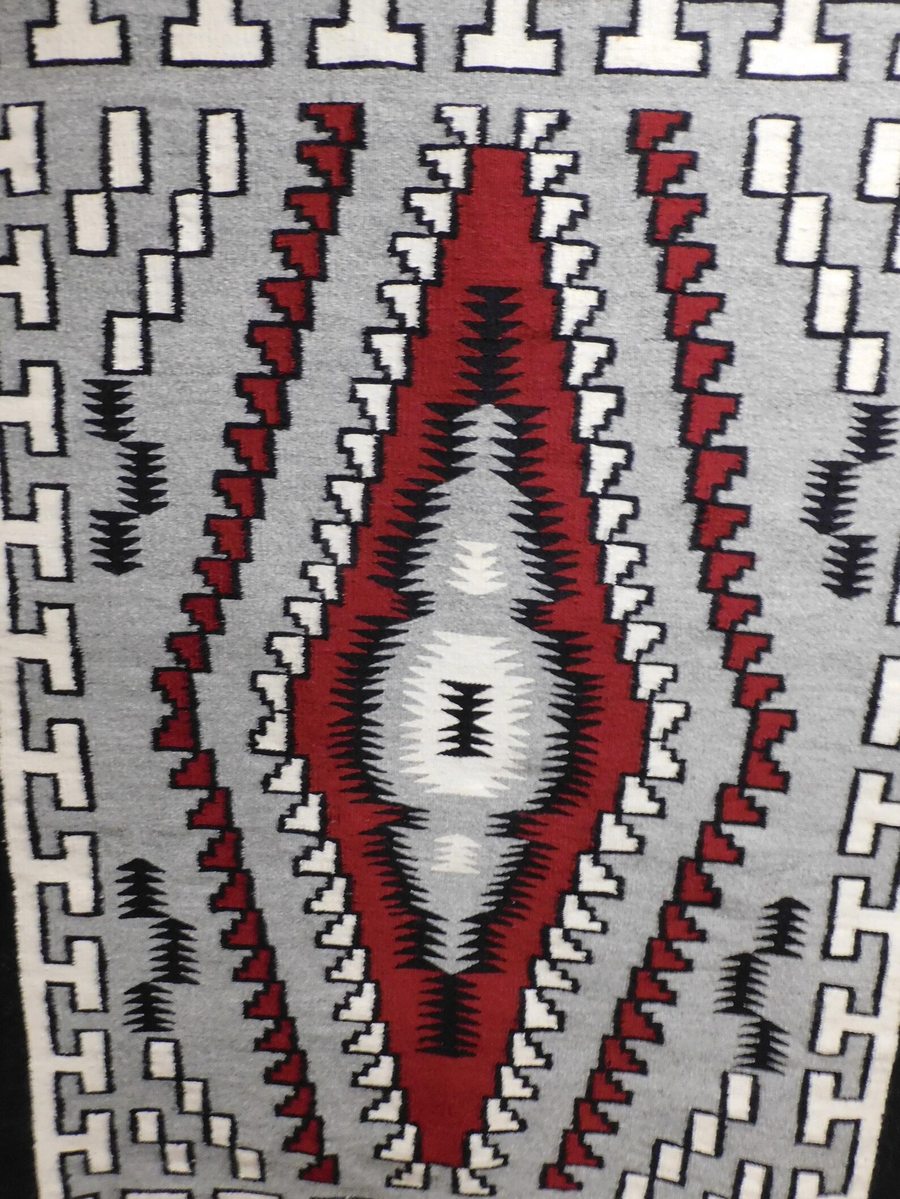
Two Grey Hills Navajo weaving

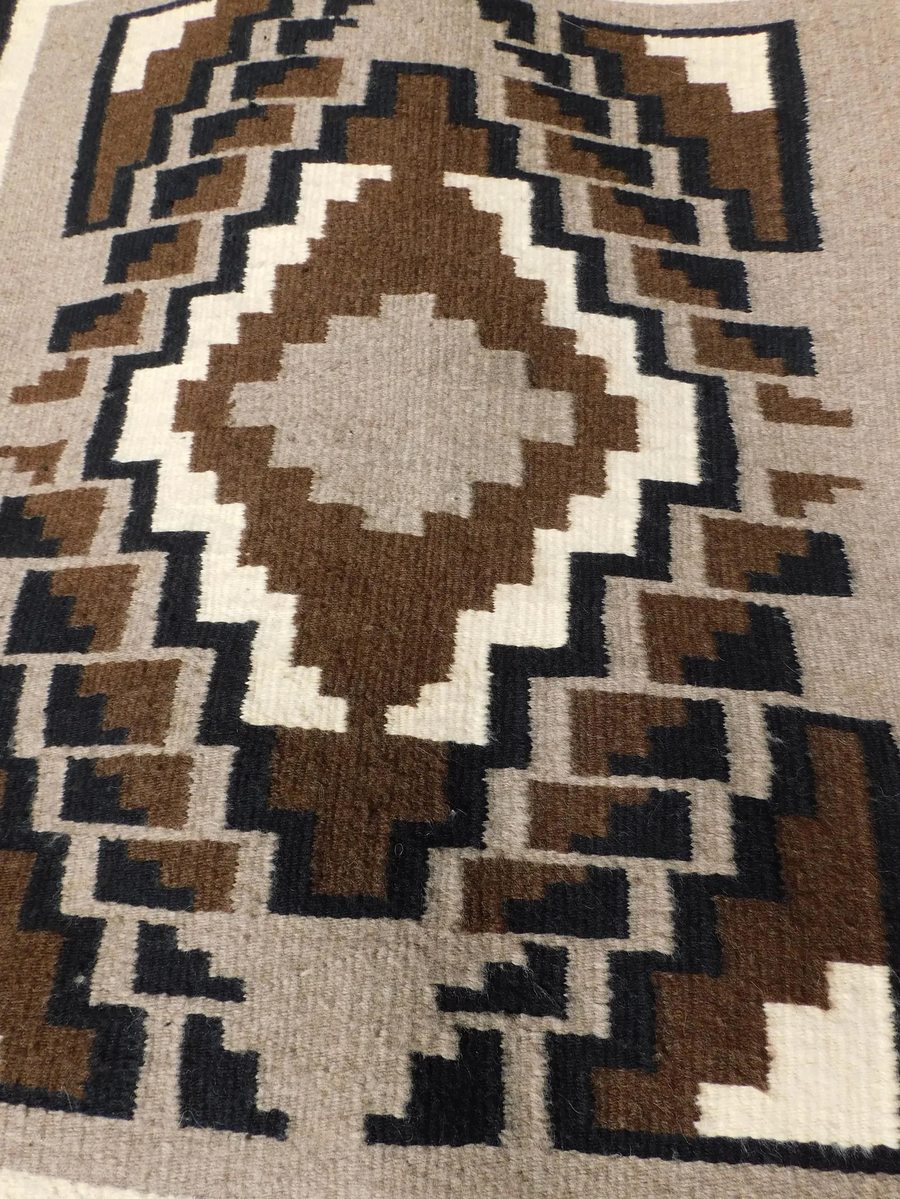
Two Grey Hills

Named for a trading post in northeastern New Mexico, Two Grey Hills is considered by many collectors to represent the pinnacle of Navajo weaving craft. Weavers use only the natural colors of Churro wool — white, brown, black, and the grey made by blending — with no dye of any kind. The designs are typically a central medallion on a tan field, surrounded by intricate geometric borders of extraordinary fineness. Weft density in fine Two Grey Hills pieces can reach 80–100 picks per inch — some of the tightest flat-weave work produced anywhere in the world.

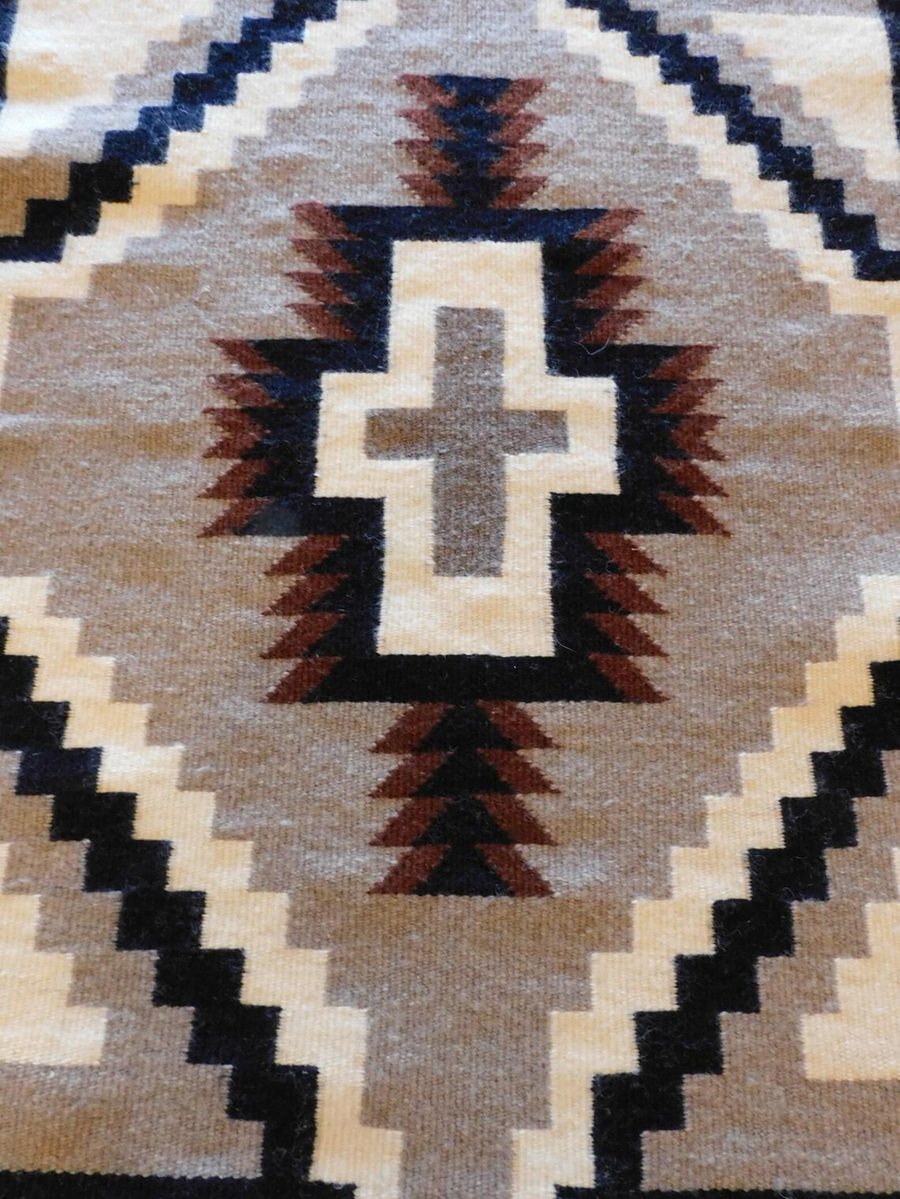
Ganado Navajo rug

Ganado

The Ganado style is the most immediately recognizable in all of Navajo weaving: bold red fields and geometric patterns in black and white, with occasional grey accents. Lorenzo Hubbell, the trading post operator at Ganado, Arizona, actively encouraged this palette in the late 19th century — believing that Eastern buyers preferred the boldness of red-dominant designs. He was correct, and the Ganado style became the commercial standard against which all Navajo rugs were measured. Authentic antique Ganado pieces are among the most collected Navajo works.

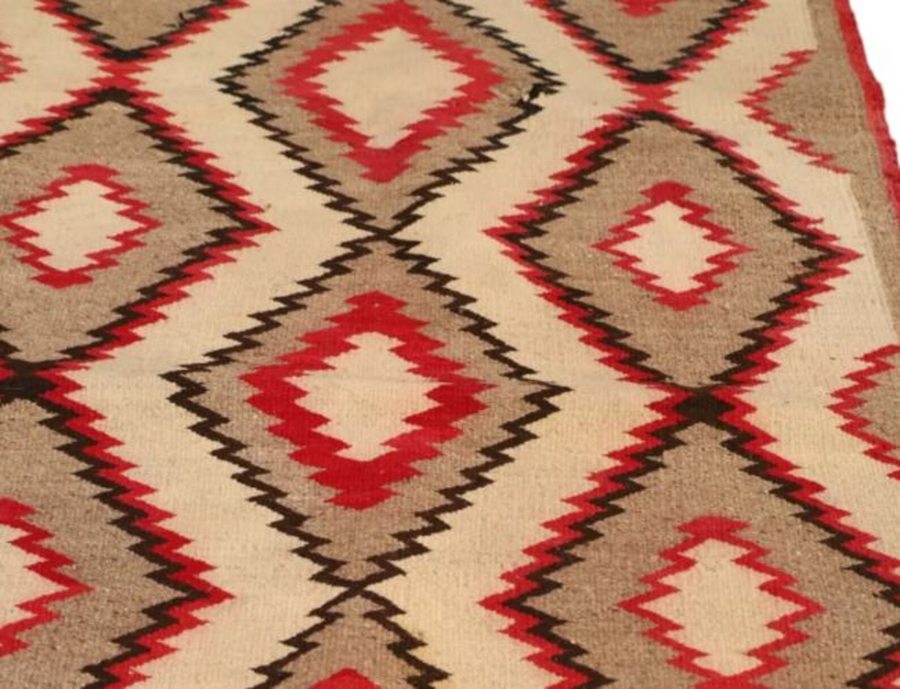
Eye Dazzler Navajo weaving

Eye Dazzler

The Eye Dazzler emerged in the 1880s when finely spun, brilliantly colored Germantown commercial yarns became available through trading posts. Weavers seized these new materials and created compositions of cascading zigzag diamonds in color combinations of deliberate optical intensity — designs that seem to vibrate and shift as you look at them. Eye Dazzlers represent one of the most exuberant creative moments in American textile history: weavers with centuries of geometric mastery suddenly given access to an unlimited palette, and using it without restraint.

Contemporary Navajo weaving

Contemporary Navajo

Today's Navajo weavers work at the intersection of living tradition and contemporary art practice. The finest contemporary pieces — particularly from the Wide Ruins, Crystal, and Two Grey Hills communities — command prices equivalent to significant works on paper or canvas. Many weavers now sign their work, control their own sales, and exhibit in fine art contexts. The natural dye revival initiated in the 1930s continues to deepen, with weavers maintaining seed-to-textile practices that preserve the full botanical and cultural knowledge of their tradition.

How We Clean Navajo Textiles

Flat-woven construction and the risk of iron-mordant rot require a protocol tailored specifically to Navajo work.

01

Black Wool Assessment

Before anything else, we examine all black-dyed areas for iron rot — the brittleness caused by iron-mordant dye chemistry reacting with wool fiber over decades. Compromised black areas are documented and, if fragile, treated conservatively throughout the cleaning process to prevent further loss.

02

Dye Bleed Testing

Aniline-dyed commercial-era pieces (post-1880) are tested for dye stability before any water contact. Synthetic aniline dyes — particularly reds and purples — can bleed dramatically. We test each color field individually and adjust our cleaning approach based on results, using cold water and minimal agitation for unstable pieces.

03

Dry Soil Removal

Because Navajo flat-weaves have no pile to buffer the foundation, embedded grit sits directly against the warp and weft fibers. We perform thorough dry dusting before any wet cleaning — the grit that remains during washing acts as an abrasive that can cut through fibers weakened by age or iron rot.

04

Gentle Immersion Wash

Navajo textiles are washed using our flat-weave protocol: full immersion in cool, pH-neutral solution with minimal agitation. We never use rollers, brushes, or any mechanical action on flat-woven pieces. The smooth weft-faced surface responds well to immersion — the natural wool brightens significantly after a proper wash.

05

Flat Drying

Navajo textiles must dry completely flat — never hung, never folded while damp. Hung drying stresses the warp under the textile's own wet weight and can cause irreversible distortion. We dry all flat-woven pieces horizontally on our drying racks, checking dimensions against pre-wash measurements to ensure the piece retains its shape.

06

Selvage & Edge Inspection

After drying, we inspect all four selvage edges — the defining structural feature of authentic Navajo work. Loose or fraying selvage cords are among the most common repair needs in antique pieces. Our craftswomen can restitch and reinforce selvages using period-appropriate technique, preserving both the structural integrity and the textile's authenticity.

Have a Navajo Textile That Needs Care?

Whether it's a Classic Period blanket, an antique Ganado rug, or a contemporary Two Grey Hills masterwork, our craftswomen have the expertise to clean and restore it properly.

Clean My Navajo Rug Browse Navajo Rugs Design a Custom Rug