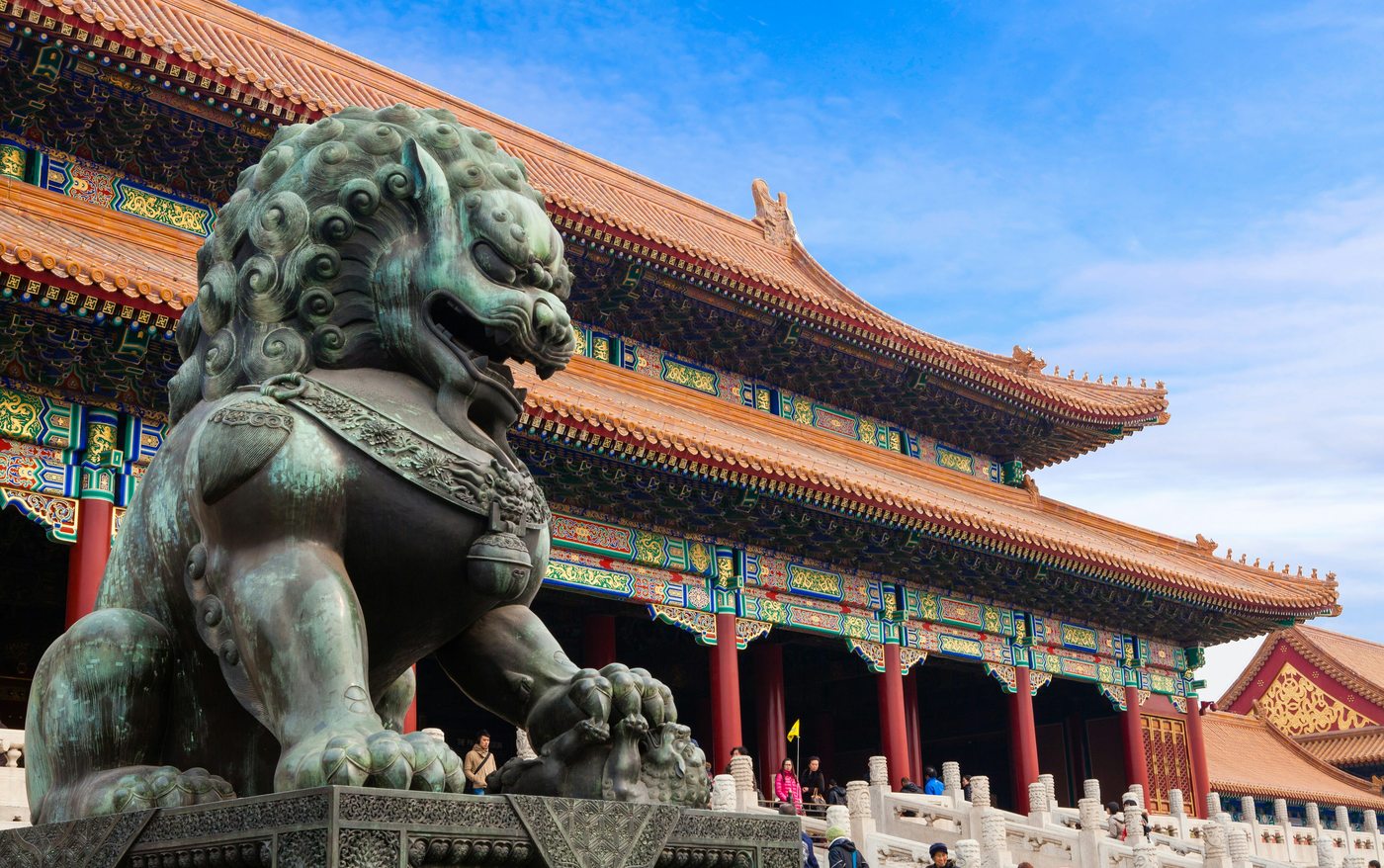
Bronze guardian lion statue at the Forbidden City with ornate imperial palace architecture — Beijing, China
Home  /  Regions  /  China
Region 10 of 13

Weavings of the
Imperial Courts

Chinese rug weaving stretches back over two millennia, but reached its artistic pinnacle in the imperial workshops of the Ming and Qing dynasties. From the earliest Ningxia meditation mats to the carved Peking carpets of the 19th century and the bold Art Deco export rugs of the 1920s, Chinese weaving has always stood apart — defined by sculptural carved pile, symbolic motifs, and an aesthetic uniquely its own.

2,000+ yr
Weaving History
Carved Pile
Signature Technique
Ningxia
Oldest Tradition
Knot Type
Asymmetrical (Persian) knot · Symmetrical in some regions
Primary Fiber
Wool · Silk · Cotton foundation
Key Centers
Ningxia · Beijing (Peking) · Tianjin · Gansu
Iconic Styles
Ningxia · Peking · Art Deco · Contemporary Carved
Hallmark
Carved pile relief creating three-dimensional texture

From Meditation Mat
to Art Deco Masterpiece

The earliest Chinese rugs were woven in the northwestern province of Ningxia — small meditation mats and pillar wraps for Buddhist monasteries, featuring simple but powerful motifs: dragons, phoenixes, cloud bands, and the endless knot. These pieces, produced from the 17th century onward, are among the most collectible antique textiles in the world.

By the 19th century, carpet production had shifted to Beijing (then Peking) and Tianjin, where larger workshop carpets featured the carved pile technique that defines Chinese weaving. Skilled craftsmen sculpted the pile surface with scissors, creating three-dimensional relief effects — raised medallions, incised borders, and beveled transitions between colors that no other weaving tradition has ever replicated.

In the 1920s and 1930s, Chinese workshops began producing Art Deco carpets for Western export — bold geometric designs in lavender, jade green, and imperial gold that became icons of modernist interior design. These pieces, along with fine Peking carpets and rare Ningxia antiques, represent the full spectrum of one of the world's most distinctive rug traditions.

The Carved Pile Technique

China's signature contribution to rug art: after weaving, craftsmen use angled scissors to carve channels between colors and sculpt motifs in relief. This creates a three-dimensional surface — shadows fall naturally into the carved grooves, and motifs appear to float above the background. No machine can replicate this hand-sculpted quality.

Imperial Symbolism

Chinese rug motifs carry centuries of symbolic meaning. The five-clawed dragon represents imperial authority; the phoenix symbolizes the empress; peony stands for wealth and honor; the bat signifies happiness. Collectors value these pieces for their symbolic literacy as much as their visual beauty.

Ningxia vs. Peking

Ningxia rugs (17th–19th century) are small, tribal in character, and use natural dyes with a limited but powerful palette. Peking rugs (19th–20th century) are larger workshop productions with refined carved pile, elaborate borders, and broader color ranges. Understanding this distinction is essential for proper identification and valuation.
Construction &
Carved Relief

Sculptural pile work that no other weaving tradition has achieved

Pile Carving

The defining technique of Chinese rugs: after the rug is woven and washed, skilled craftsmen use specially angled scissors to carve V-shaped channels between color areas. Design motifs are then sculpted in relief — dragons, flowers, and borders are raised above the ground, creating dramatic shadow effects. This post-weaving step can take as long as the original knotting and requires exceptional artistic skill.

Knot Density

Ningxia
30–60 KPSI
Peking
60–90 KPSI
Art Deco
70–100 KPSI
Fine Silk
200–400 KPSI

Chinese knot densities vary enormously by type. Coarser Ningxia pieces have the character of tribal weaving; fine silk Hereke-influenced pieces rival the densest Persian work.

Chemical Washing

Chinese carpets undergo distinctive chemical wash treatments that soften the wool, mellow the colors, and create a lustrous sheen. The "antique wash" uses mild chemical solutions to age the surface artificially — creating muted tones and a silky hand. "Aubusson wash" bleaches the entire carpet to soft pastels. Understanding which wash was applied is critical for cleaning, as it determines how the rug will respond to water and chemistry.

A Living Craft

17th–18th c.
Ningxia Period
Small meditation mats and pillar wraps produced in northwestern China for Buddhist monasteries. These pieces — with their natural dyes, coarse knot, and powerful dragon and cloud motifs — are now among the most sought-after antique textiles in the world.
19th c.
Peking Workshops
Production shifts to Beijing and Tianjin. Larger room-size carpets emerge with refined carved pile technique, elaborate medallion designs, and broader color palettes. These workshops establish the carved relief style as China's signature contribution to rug art.
1920s–1930s
Art Deco Export Era
Walter Nichols and other Western entrepreneurs commission bold Art Deco designs from Chinese workshops for the American and European market. These carpets — in lavender, jade, and gold with geometric and floral motifs — become icons of modernist interior design.
Present
Contemporary Production
Modern Chinese production spans the full quality spectrum — from mass-produced tufted rugs to extraordinary hand-knotted silk pieces rivaling the finest Persian work. The carved pile tradition continues in both traditional and contemporary designs, keeping alive a technique found nowhere else.

Fibers & Materials

From coarse monastery wool to luminous silk — China's material range

🐑
Chinese Wool
Primary Pile Fiber
Chinese wool varies significantly by region. Ningxia and Gansu province produce coarser, more lustrous wool prized for its durability and sheen after washing. Modern production often uses imported wool (New Zealand or Australian) for finer pieces. The wool's response to chemical washing is central to the Chinese rug aesthetic.
🧵
Chinese Silk
Luxury Pile Fiber
China has been the world's primary silk producer for millennia. Chinese silk rugs — particularly those from Hereke-influenced workshops — achieve extraordinary knot densities (300–400+ KPSI) with remarkable design precision. Pure silk Chinese rugs are among the most luminous textiles ever produced.
🌾
Cotton Foundation
Warp & Weft
Cotton provides the structural base for most Chinese rugs. The cotton foundations of Peking and Art Deco carpets are typically thicker and more rigid than those of Persian rugs, giving Chinese carpets a distinctive stiffness and weight that contributes to their flat lay and durability.
🎨
Chemical Wash Finishes
Surface Treatment
Not a fiber but a defining material characteristic: virtually all Chinese carpets undergo chemical wash treatment. "Antique wash" mellows and lustres; "Aubusson wash" bleaches to pastels; "tea wash" adds warm golden tones. These treatments fundamentally alter the wool's properties and must be understood for proper care.
Mercerized Cotton
Silk Substitute
Some Chinese rugs marketed as "silk" actually use mercerized cotton — cotton treated with sodium hydroxide to create a silky sheen. While attractive when new, mercerized cotton crushes easily, water-stains permanently, and lacks silk's resilience. Identification before cleaning is essential.
⚠️
Artificial Silk (Viscose)
Caution — Not Genuine Silk
A significant percentage of "silk" Chinese rugs on the market are actually viscose (rayon/art silk). These fibers crush permanently, water-spot, and cannot be wet-cleaned. We perform burn testing on every Chinese silk rug before cleaning to verify fiber content — this single step prevents the most common cause of cleaning damage.

Dyes & Color

Imperial Blue
Natural / Synthetic · Indigo
The most iconic Chinese rug color — deep, saturated blue ranging from cobalt to navy. Antique Ningxia pieces achieve this with natural indigo; later Peking and Art Deco rugs use synthetic equivalents. Remarkably stable in both forms.
Imperial Gold
Natural / Synthetic · Various
Golden yellow — the color of the emperor. In antique pieces, achieved with pagoda tree buds or pomegranate rind. Art Deco carpets use chrome yellows for brilliant, stable gold. A defining color of the Chinese palette alongside blue.
Cinnabar Red
Natural / Synthetic · Madder
Rich oxblood to cinnabar red — used for borders, medallions, and ground colors. Antique pieces use madder root; later production employs synthetic alizarin. Chemical washing often softens these reds to warm rose tones.
Art Deco Lavender
Synthetic · Chrome Dye
The signature color of Chinese Art Deco carpets — soft lavender and mauve tones that were revolutionary in the 1920s rug market. These synthetic dyes are generally stable but can shift toward gray with improper cleaning chemistry.
Ivory Ground
Undyed / Tea Wash
Cream to ivory grounds are ubiquitous in Chinese carpets — either natural undyed wool or white wool tea-washed to warm gold. These light grounds showcase the carved pile technique beautifully but require careful cleaning to avoid yellowing or browning.
Jade Green
Synthetic · Chrome Dye
Jade and celadon greens appear frequently in Art Deco and contemporary Chinese rugs. These chrome-based dyes are highly stable and colorfast. Green — symbolic of spring, growth, and harmony — adds freshness to the characteristically warm Chinese palette.

Rug Styles

From ancient monastery mats to modernist masterworks

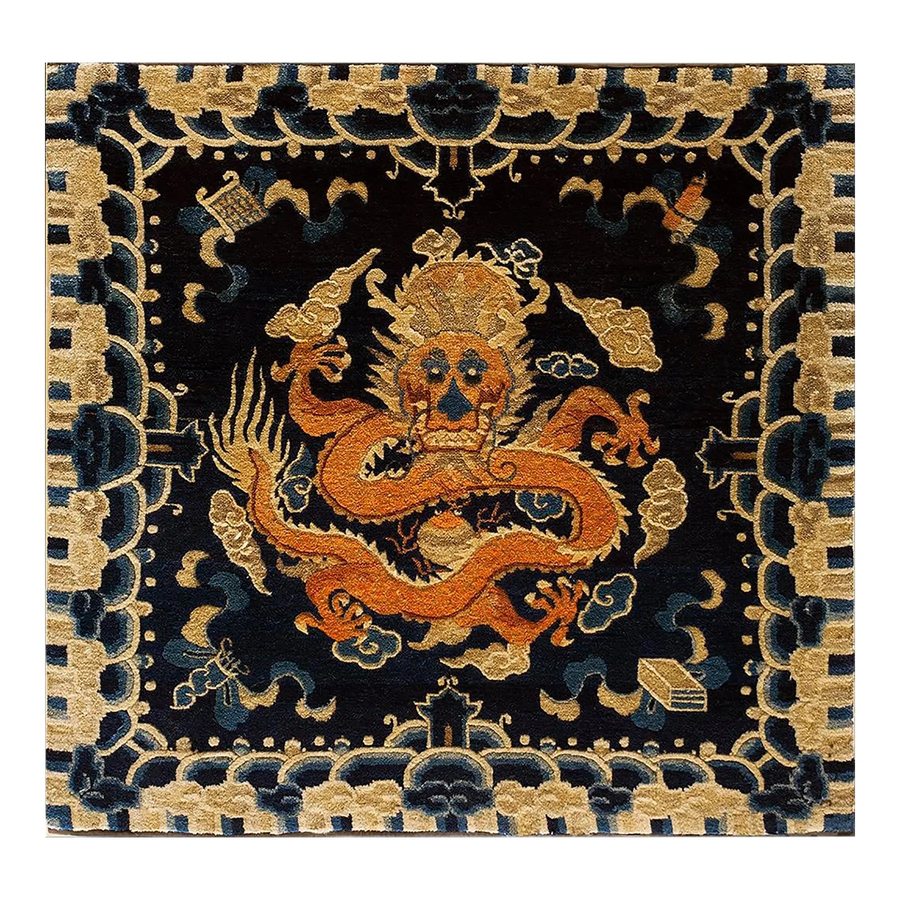
Antique Ningxia Chinese rug with imperial five-clawed dragon on dark ground with cloud bands and gold border
Ningxia Province · 17th–19th c.
Ningxia Antique
The oldest and most collectible Chinese rug type. Small meditation mats, pillar wraps, and saddle covers featuring dragons, phoenixes, cloud bands, and Buddhist symbols on blue or tan grounds. Natural dyes, coarse knot, and a distinctive lustrous wool characterize these rare pieces. Authentic Ningxia antiques command extraordinary prices at auction.
Antique Natural Dyes Buddhist Motifs Highly Collectible
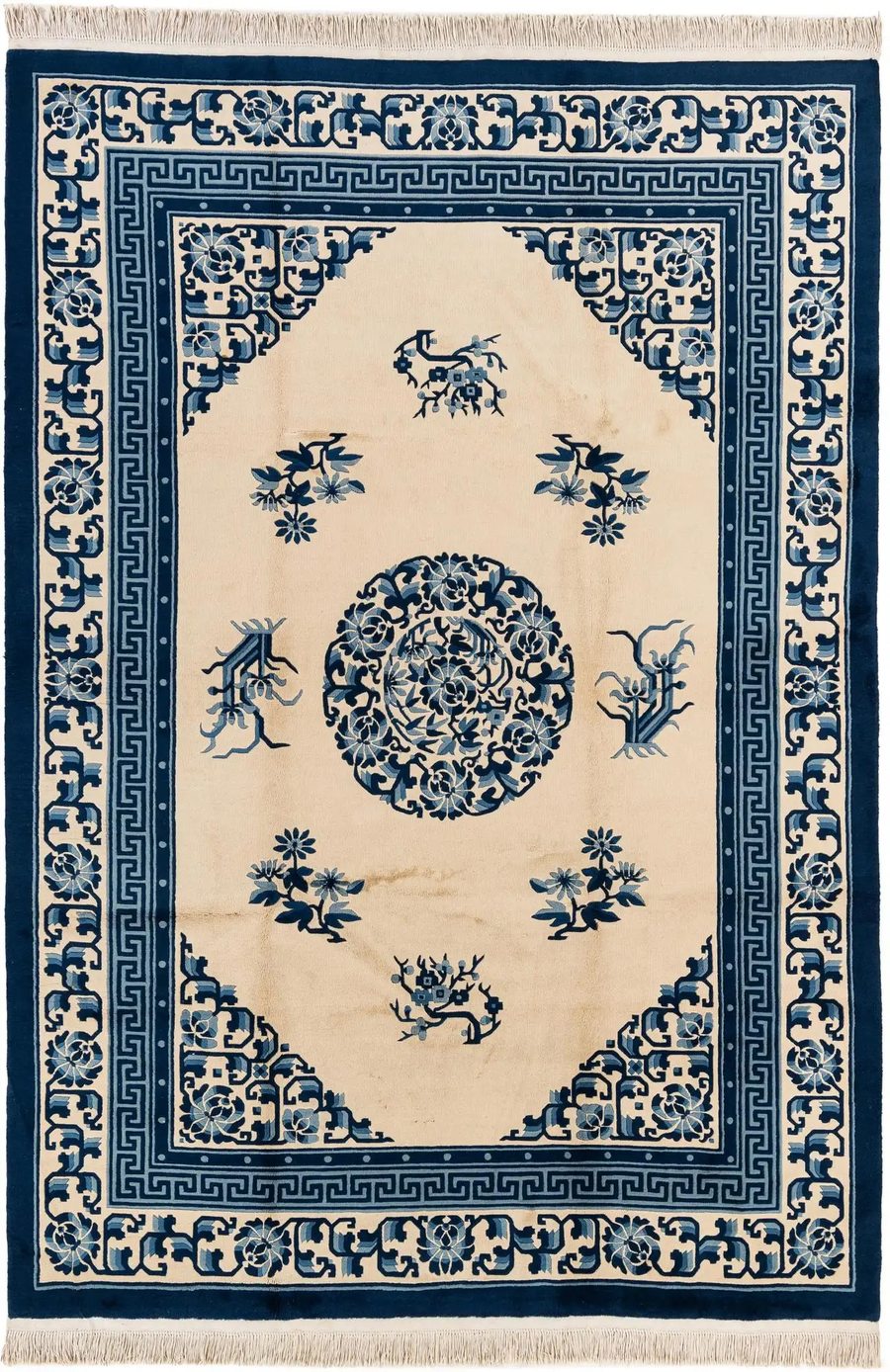
Classic Peking carved Chinese rug with ivory ground blue floral medallion and Greek key border with fringe
Beijing · Tianjin · 19th–20th c.
Peking Carved
The classic Chinese room-size carpet — ivory or blue grounds with elaborately carved medallion designs featuring peonies, dragons, and geometric fretwork borders. The carved pile technique reaches its fullest expression in these pieces: motifs stand in three-dimensional relief, with beveled edges creating natural shadow effects. Chemical-washed to a lustrous, silky finish.
Carved Pile Room Size Medallion Chemical Wash
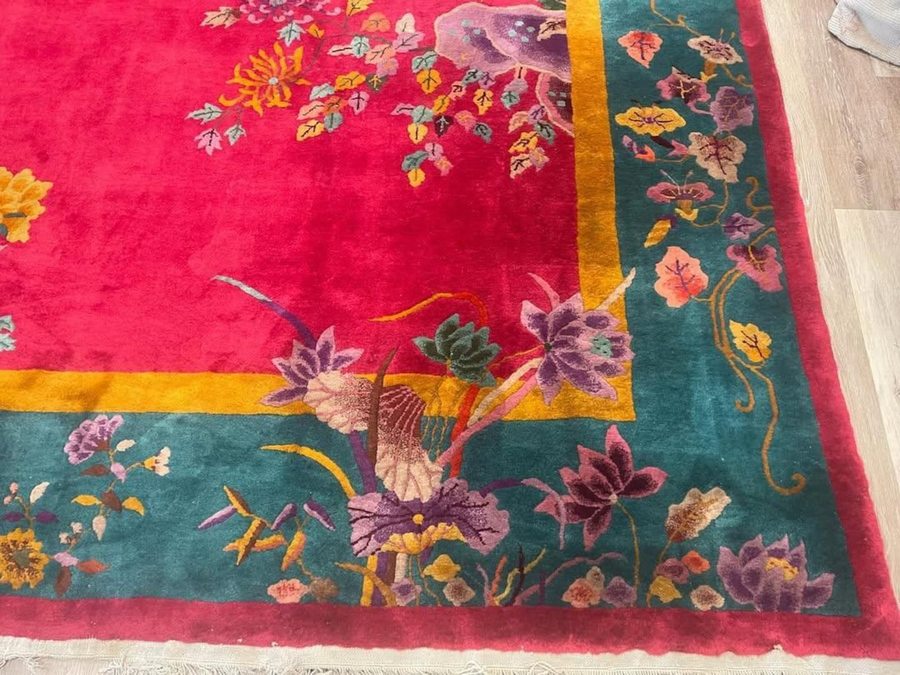
Chinese Art Deco rug corner detail with vivid red ground teal border gold trim and carved floral motifs
Beijing · Tianjin · 1920s–1940s
Art Deco Export
Bold, graphic designs created for Western markets during the Art Deco era. Lavender, jade green, gold, and black in geometric and stylized floral patterns — often with asymmetric compositions revolutionary for their time. Walter Nichols rugs are the most recognized name. Surviving examples in good condition are increasingly collectible as icons of 20th-century design.
1920s–1940s Geometric Lavender & Jade Nichols
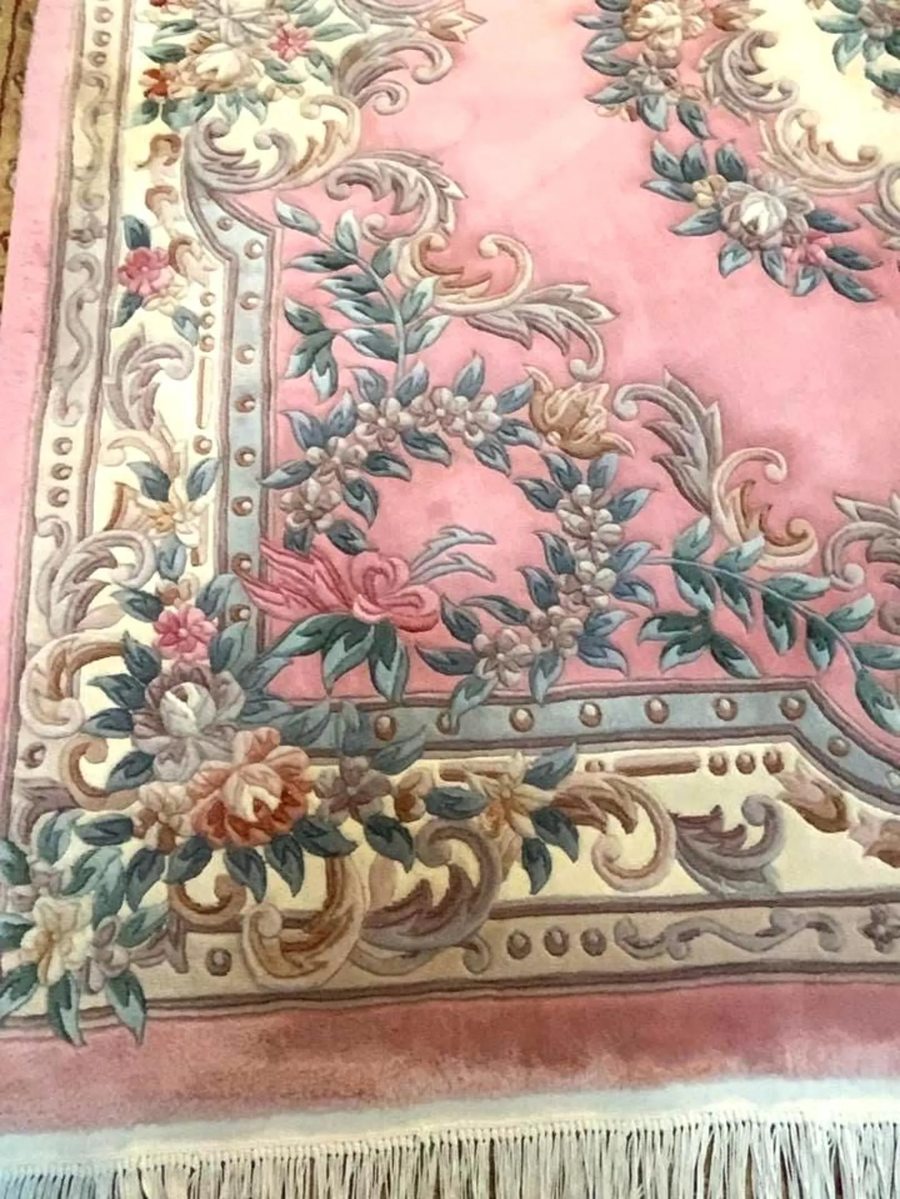
Contemporary carved Chinese rug in pink with elaborate floral scrollwork in cream and teal with fringe
Various · Contemporary
Contemporary Carved
Modern Chinese production continues the carved pile tradition in both traditional and contemporary designs. Quality ranges enormously — from mass-produced pieces with minimal carving to extraordinary hand-knotted rugs with deep sculptural relief. The best contemporary Chinese carpets combine ancient carved pile techniques with modern design sensibility, creating pieces of genuine artistic merit.
Contemporary Carved Relief Wide Quality Range Wool & Silk

How We Clean
Chinese Rugs

Chemical wash finishes and carved pile demand specialized protocols at every step

01
Fiber Verification
The single most critical step for Chinese rugs. We burn-test fiber samples to distinguish genuine silk from mercerized cotton and viscose — three materials that look identical but respond to water and chemistry in completely different ways. A viscose rug treated as silk will be ruined. This 60-second test prevents the most common cause of cleaning disasters.
02
Wash Type Identification
We identify which chemical wash was originally applied — antique wash, Aubusson bleach, tea wash, or no wash. This determines our cleaning chemistry. Aubusson-washed rugs are particularly sensitive: the bleaching process weakens fibers, and aggressive cleaning can strip the finish entirely, dramatically changing the rug's appearance and value.
03
Dye Stability Testing
Chinese rugs with red or blue areas adjacent to ivory grounds are tested carefully for dye bleed. Chemical-washed rugs can have altered dye bonds — colors that were stable before washing may bleed after the chemical treatment. We test each color area individually before any wetting begins.
04
Controlled Washing
Genuine wool and silk Chinese rugs respond beautifully to proper immersion cleaning — the chemical wash finish is preserved and refreshed. We use pH-neutral chemistry matched to the fiber type, with careful temperature control. Viscose and mercerized cotton pieces receive dry or low-moisture cleaning only — they cannot be immersed.
05
Carved Pile Protection
The carved channels and relief details that define Chinese rugs require careful handling during cleaning. We avoid aggressive mechanical action that could blur carved edges, and use directional grooming to maintain the sculptural definition. Improperly cleaned Chinese rugs lose their carved detail — the feature that gives them their distinctive character.
06
Drying & Finish Restoration
Chinese rugs are dried flat with controlled airflow. Once dry, the pile is groomed directionally to restore the lustrous sheen that chemical washing creates, and carved details are touched up with hand grooming. The goal is to return the rug looking exactly as it did when new — with the carved relief and surface luster fully intact.

Expert Care for Your
Chinese Rug

Whether it's a rare Ningxia antique, a classic Peking carpet with deep carved pile, or a luminous Chinese silk — our team provides the fiber-specific, finish-aware care that Chinese rugs demand.

Clean My Chinese Rug → Browse Chinese Rugs → Design a Custom Rug →